To clean an Oriental rug at home, vacuum both sides without a beater bar, blot spills immediately with a white cloth and cool water, and never scrub or use harsh chemicals. For deep cleaning, pet odor, or any hand-knotted or natural-dye rug, use a professional full-immersion wash to avoid color bleed and fiber damage.
Certifications and service details current for 2026.
“Oriental rug” covers a wide family of hand-woven rugs, Persian, Turkish, Caucasian, Indian, Chinese, Pakistani and more, made mostly of wool, sometimes silk, on a cotton or wool foundation. What they share is that they are woven textiles rather than manufactured floor covering, and they need to be cleaned like textiles.
What counts as an Oriental rug?
The term describes hand-woven rugs from the traditional weaving regions of Asia and the Middle East. Some are hand-knotted with hundreds of knots per square inch; others are flat-woven kilims or soumaks with no pile at all. Construction matters more than the label, because a hand-knotted rug on a cotton foundation and a machine-made copy of the same design need completely different handling.
How do you care for an Oriental rug at home?
Vacuum gently on both sides every week or two using suction only, beater bars pull at knots and fringe. Rotate the rug twice a year to even out wear and sun exposure. Blot spills right away with a clean white cloth and cool water, working from the edge inward; never rub, which pushes the spill deeper.
- Take your shoes off on it. Street grit is the single biggest cause of wear. It settles at the base of the pile and cuts wool fibers every time someone walks across the rug.
- Vacuum slowly, with the nap. Run your hand over the pile to find the smooth direction and vacuum that way. Two or three times a year, turn the rug over and vacuum the back to shake grit down out of the weave.
- Keep the vacuum off the fringe. On a hand-knotted rug the fringe is the end of the warp threads holding the whole rug together, not a trim. Comb it straight by hand instead.
- Blot, then stop. Press a white cotton cloth into a fresh spill, work inward from the edge, and repeat with a little cool water until nothing more transfers. Do not add product.
- Dry any damp area fast. A fan and airflow. Wool that stays wet felts, cotton foundations that stay wet rot, and both start to smell.
How do you tell what your rug is made of?
Look at the back. On a hand-knotted rug the pattern is as clear on the reverse as on the face, and the knots are visibly irregular; a machine-made rug has a flat, uniform back, often with a mesh or latex backing. Fringe that is sewn on rather than continuous with the foundation is another sign of machine construction.
Fiber matters just as much as construction, and silk, wool, viscose and polypropylene all respond differently to water. Our guide on telling wool, silk, and synthetic apart walks through the checks, and any inspection here confirms it before we quote.
What not to do
Avoid steam cleaners, drugstore spot removers, and vigorous scrubbing on Oriental rugs, these can set stains, strip natural oils, and cause dyes to bleed. Standing water and slow drying can also rot the foundation.
Why is scrubbing so damaging?
Wool fibers are covered in microscopic scales. Heat, moisture, and agitation together make those scales lock into each other, and the pile mats permanently into a felted, stiff patch that no amount of later cleaning will fluff back out. Scrubbing also drives the spill down into the foundation, where it is out of reach of blotting and free to wick back up as the rug dries.
How do you get a spill out of an Oriental rug?
Speed beats product every time. Lift what you can with a spoon or a dull edge, then press a white cotton cloth straight down and work from the outside of the spill inward so you are not spreading it. Dampen lightly with cool water, blot again, and keep going until little transfers. If the color of the rug starts appearing on your cloth, stop immediately, the dye is moving and the rug needs a controlled wash.
What should you do about pet urine?
Blotting only reaches the top. Urine soaks straight through the pile into the foundation, where its salts stay hygroscopic, pull humidity back out of the air, and keep the odor returning on damp days. The alkalinity also attacks dyes and weakens a cotton foundation over time. A set-in accident needs full-immersion pet odor and stain removal, not a surface treatment, there is a detailed walkthrough in our guide to getting pet urine out of a wool rug.
Identified before it is washed
Fiber, dyes, and construction are checked first, then the wash is built around the rug.
“They correctly identified each rug’s origin and construction, which gave me immediate confidence that they understood what they were handling.”
Verified Google review · 5.0★ from 303 reviews
| Do | Don’t |
|---|---|
| Vacuum both sides with suction only | Use a beater bar or vacuum the fringe |
| Blot cool water, edge inward | Scrub, rub, or use hot water |
| Dry damp areas quickly with airflow | Leave the rug wet or dry it in direct sun |
| Test any product in a hidden corner | Use bleach, vinegar, or drugstore spot removers |
| Have deep soil washed by immersion | Clean a hand-knotted rug with a rented machine |
Is cleaning an Oriental rug different from carpet cleaning?
Completely different processes. Carpet cleaning happens in place and is a surface operation: what goes in has to come back out through the same extraction head, and the rug dries on your floor. An Oriental rug needs to be taken off the floor, dusted dry, submerged, rinsed until the water runs clear, and dried under control. Our comparison of Oriental rug cleaning versus carpet cleaning lays out where the two diverge.
When to call a professional
Deep soil, pet urine, and any fine hand-knotted or natural-dye rug should be professionally cleaned. Our Oriental rug cleaning uses dye-tested, full-immersion hand-washing that removes what at-home care can’t, safely.
Every rug is inspected first and you get an exact written price before any cleaning begins, so there is no cost to finding out what your rug needs. Most rugs are back with you in 7 to 10 business days; antiques, heavy pet contamination, and repair work take longer.
What does a full-immersion wash involve?
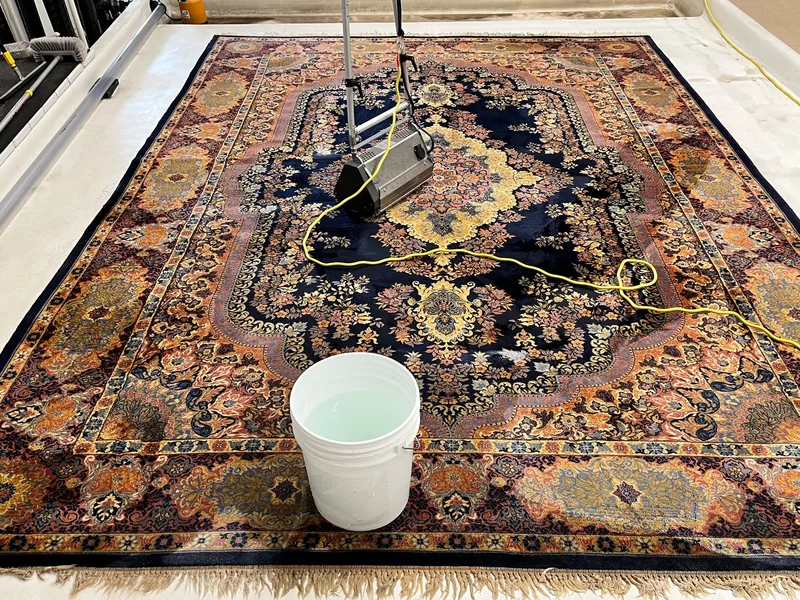
Inspection and dye testing, then dusting to drive out dry soil mechanically, then a hand wash by full immersion with solutions matched to the fiber. The rug is rinsed until the water runs clean, dried under controlled temperature and airflow rather than left to sit damp, and finally groomed so the pile lies the way it was woven. The full sequence is on our rug washing process page.
How often should an Oriental rug be washed?
Roughly every one to two years for a rug in a main living area, annually with pets or children, and longer for a rug in a low-traffic room. A useful test: press your palm hard into the pile and rub. If your hand comes away gritty or grey, the rug is carrying soil that vacuuming is no longer reaching.
How do you store an Oriental rug?
Clean it first, because food residue, skin cells, and pet traces are exactly what attracts moths. Roll it around a tube with the pile facing inward rather than folding it, since a fold line in a cotton foundation can crack. Wrap it in breathable cotton, not plastic, which traps moisture against the fibers, and keep it off a concrete floor in a cool, dry space. Unroll it once a year to check for moth activity.
Keep reading
Ready for a wash?
Oriental rug cleaning questions
Is cleaning an Oriental rug different from carpet cleaning?
Completely. Carpet cleaning is a surface process done in place; an Oriental rug needs to be submerged and washed by hand so soil is flushed out of the foundation. The dyes and hand-knotted construction also need testing before any water is applied.
Can I use a carpet cleaning machine on an Oriental rug?
We would not. Rented and truck-mounted machines push hot water and detergent into a rug that then cannot be rinsed or dried properly. That is the most common cause of the dye bleeding, stiff foundation, and musty smell we see on rugs brought to us afterwards.
How do I get a spill out of an Oriental rug?
Blot immediately with a clean white cloth, working from the outside of the spill inward, using plain cool water. Do not scrub or apply a cleaning product. If the spill is pet urine, wine, or anything dyed, call us before it dries into the foundation.
Not sure what your rug needs?
Free pickup across the Treasure Valley and a free written inspection, no obligation to proceed.
Sources & industry standards
- IICRC, the Institute of Inspection, Cleaning and Restoration Certification: the industry body whose S100/S310 standards govern professional rug and carpet cleaning.
- The WoolSafe Organisation: independent certification for wool-safe cleaning products and methods.
- The Carpet and Rug Institute (CRI): the science-based trade authority for carpet and rug care.
- U.S. EPA, Carpets & Indoor Air Quality: guidance on how clean carpets and rugs support healthy indoor air.